Choosing between an LED wall and projection is one of the biggest media decisions a church makes. Both can work well. The right answer depends on your room, your lighting, your budget over time, and who runs it every week.
Start with the light in the room
Projection depends on a controlled room. Windows, stage lighting and haze all wash out a projected image. An LED wall makes its own light, so it holds up in bright sanctuaries and under full stage lighting. If your room has a lot of natural light or heavy lighting design, that alone can settle the question.
Size, shape and image quality
LED walls are built from modules, so the size and shape can follow the room, with no projector edges to blend and no keystone correction to fight. Projection can deliver a large image at a lower starting cost, but the result depends on throw distance, lens choice, and the screen itself. A well-planned projection setup looks good. A poorly planned one never does.
Compare cost over the life of the system
LED usually costs more up front. Projection adds ongoing costs: lamps or laser light sources, filters, screens, and eventual replacement. Ask every vendor for the full picture over five years or more, including service, spare parts and what it takes to replace a failed component. The lowest quote on day one is not always the lowest cost in year four.
Think about what happens when something fails
When a projector fails, the whole image goes down. When an LED module fails, you replace that module. Either way, plan for access before install day: who can reach the equipment, how fast parts arrive, and what the backup plan is on a Sunday morning.
Check sight lines and viewing distance
The front row sees a very different image than the balcony. For LED, the closest seat helps set the pixel pitch. For projection, sight lines and screen placement decide who sees the whole picture. We cover this step in more detail in how to plan a video wall starting with the room.
Remember who runs it on Sunday
Whichever you choose, a volunteer team will run it week after week. Look at how content gets onto the screen, how the system powers on and off, and whether a new volunteer could handle it with a one page guide. A simple system that gets used beats a powerful one that does not.
A simple way to decide
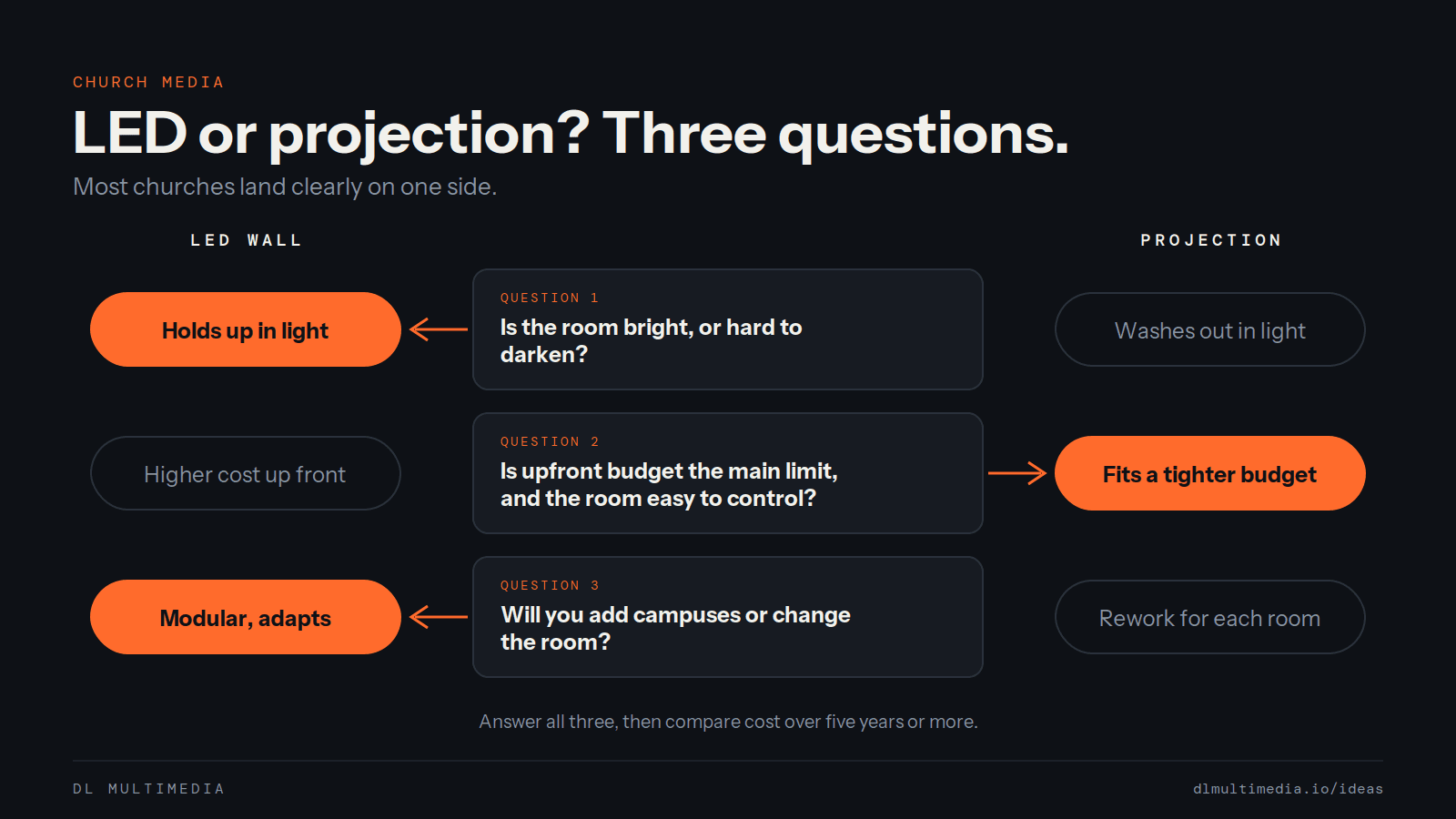
Is your room bright or hard to darken? Lean toward LED. Is the upfront budget the main limit and the room easy to control? Projection may fit. Do you expect to add campuses or change the room? Modular LED adapts more easily. Most churches land clearly on one side once they answer those three questions honestly.
Our LIIV work is an example of planning for weekly operation across multiple campuses. You can see it on our work page, or scope your church media project with us.